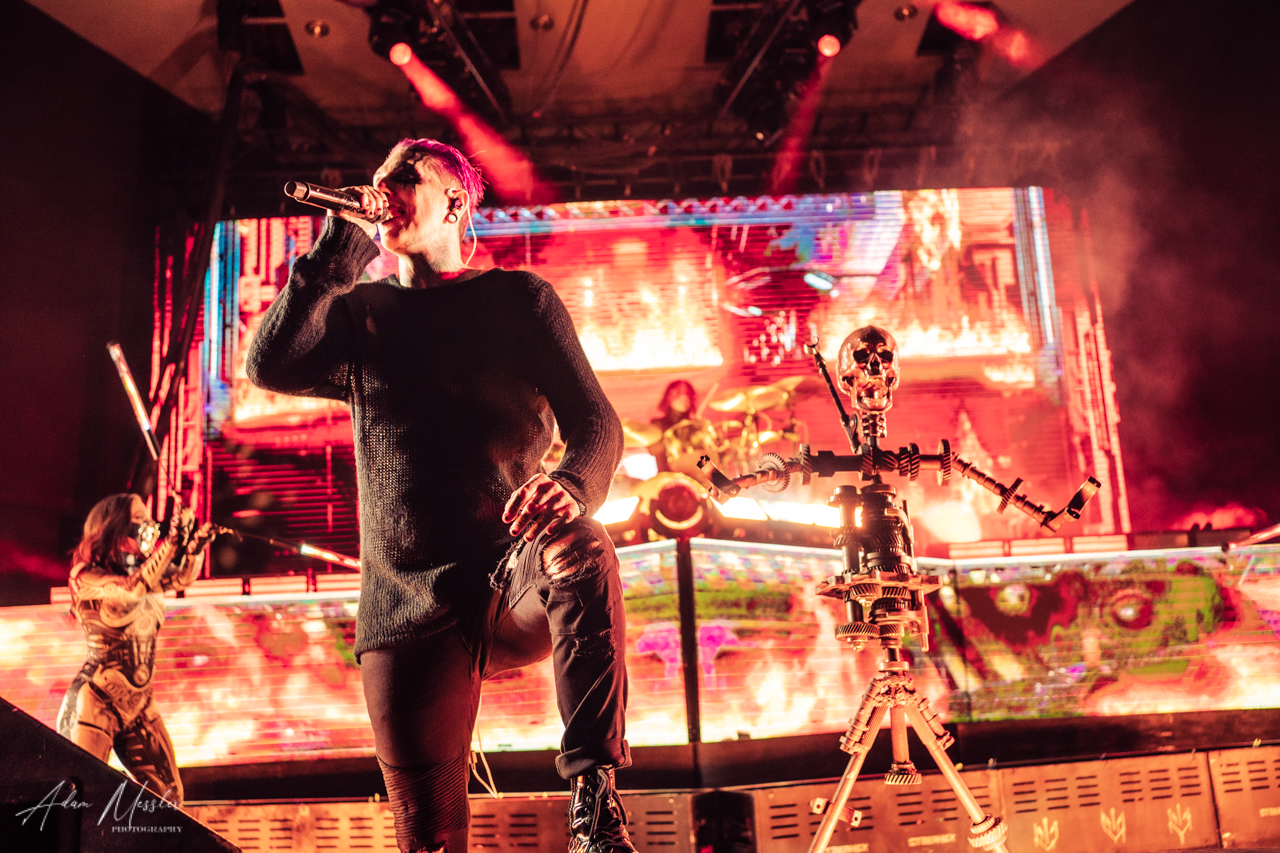
After more than 20 years of darkness, determination and relentless evolution, Motionless in White return with Decades, an album that feels less like a retrospective and more like a declaration of survival.
Released July 17 through Roadrunner Records, the band’s seventh studio album brings together the industrial aggression, gothic atmosphere, electronic experimentation and emotionally charged metalcore that have defined their career. Rather than simply revisiting old ideas, Decades reshapes those influences into one of the most confident and cohesive albums Motionless in White have produced.
The opening title track immediately establishes the album’s mindset. “Decades” is confrontational, theatrical and unapologetic, presenting a band that understands exactly what it has overcome. Chris Motionless sounds energized and defiant, while the crushing guitars, electronic textures and explosive breakdown create an introduction worthy of the album’s celebratory theme.
That momentum flows directly into “log_in//crash_out,” a glitch-heavy attack on the darker side of modern digital culture. Its mechanical rhythms and electronic production recall the cyber-metal atmosphere of “Cyberhex,” but the song feels more frantic and unstable—as though the technology surrounding it is beginning to collapse.
One of the album’s biggest strengths is its ability to move between brutality and vulnerability without losing its identity.
“R.I.P.,” featuring Skylar Grey, begins as a dark, emotionally restrained ballad before gradually becoming heavier and more dramatic. Grey’s haunting delivery complements Chris Motionless exceptionally well, giving the track a cinematic quality that feels tragic, romantic and dangerous all at once.
Then comes “Fight Like Hell,” an arena-ready anthem built around resistance, survival and refusing to stay down. Its callback to the band’s Rhea Ripley-associated “Brutality” material adds familiarity, but the song stands firmly on its own with a massive chorus and the kind of commanding energy that should translate perfectly into a live setting.
The album reaches its most violent point with “Playing God,” featuring Corey Taylor. Taylor does not appear merely as a recognizable guest name—he arrives sounding genuinely furious. His unmistakable vocal attack adds another layer of hostility to a song aimed at toxic internet culture, manufactured outrage and the endless hunger for online approval.
Despite Taylor’s presence, “Playing God” never becomes a disguised Slipknot song. Motionless in White’s sinister synthesizers, theatrical delivery and carefully constructed chorus remain at the center. The final breakdown is enormous, descending into controlled chaos as Chris and Taylor trade venomous performances.
“All That I’ve Ever Known” and “Blood Rave” push the electronic side of the album even further. The former combines metalcore destruction with glitches, drops and cybernetic production, while “Blood Rave,” featuring Anthony Martinez of Dark Divine, turns the record into a blood-soaked industrial nightclub. It is aggressive enough for the pit but hypnotic enough for a dance floor.
“Love at First Bite” provides one of the album’s most entertaining moments. Filled with Halloween-inspired keyboards, gothic romance and deliberately playful horror imagery, the song embraces the theatrical personality that has always separated Motionless in White from countless other heavy bands. It feels like a darker and more mischievous relative of “Werewolf”—catchy, campy and completely aware of what it is.
“Count Back from Zero” and “Blood Pact” continue exploring the tension between accessible hooks and mechanical heaviness. These tracks may not immediately overpower the album’s larger collaborations, but repeated listens reveal some of its most carefully layered production.
“Afraid of the Dark” brings the record back toward early-2000s metalcore, combining emotional tension with punishing riffs and a demonic breakdown. Chris Motionless delivers one of his strongest performances on the album, moving from melodic vulnerability to full-throated aggression with impressive control.
The standard edition closes with an unexpected cover of Corey Hart’s “Sunglasses at Night.” Instead of treating the song as a novelty, Motionless in White rebuild it as a sleek gothic anthem. Chris leans into a smooth, dramatic croon while the band surrounds the familiar melody with shadowy electronics and industrial atmosphere. It is strange, stylish and surprisingly natural.
What makes Decades successful is not simply its heaviness or its collection of memorable choruses. It is the sense that Motionless in White are no longer searching for the balance between their influences.
The gothic horror, industrial metal, nu-metal aggression, emotional metalcore and electronic experimentation now feel like parts of the same universe. The album honors where the band came from without becoming trapped by nostalgia, capturing elements of its past, present and possible future in one focused statement.
There are moments when the album’s constant genre shifts and massive production threaten to become overwhelming. Listeners who prefer the rawer sound of the band’s earliest work may find some of the electronic passages too polished. However, that ambition is also what makes Decades exciting. Motionless in White refuse to remain comfortable, even after reaching a point where they could easily repeat a successful formula.
After two decades, the band sounds heavier, more theatrical and more self-assured than ever.
Decades is not a farewell to the past. It is proof that everything Motionless in White have experienced—the struggle, experimentation, criticism and evolution—has prepared them for this moment.
They are still here.
They are still evolving.
And they are nowhere close to finished.
Rating: 9/10
Standout tracks: “Decades,” “Playing God,” “R.I.P.,” “Blood Rave,” “Love at First Bite” and “Afraid of the Dark”