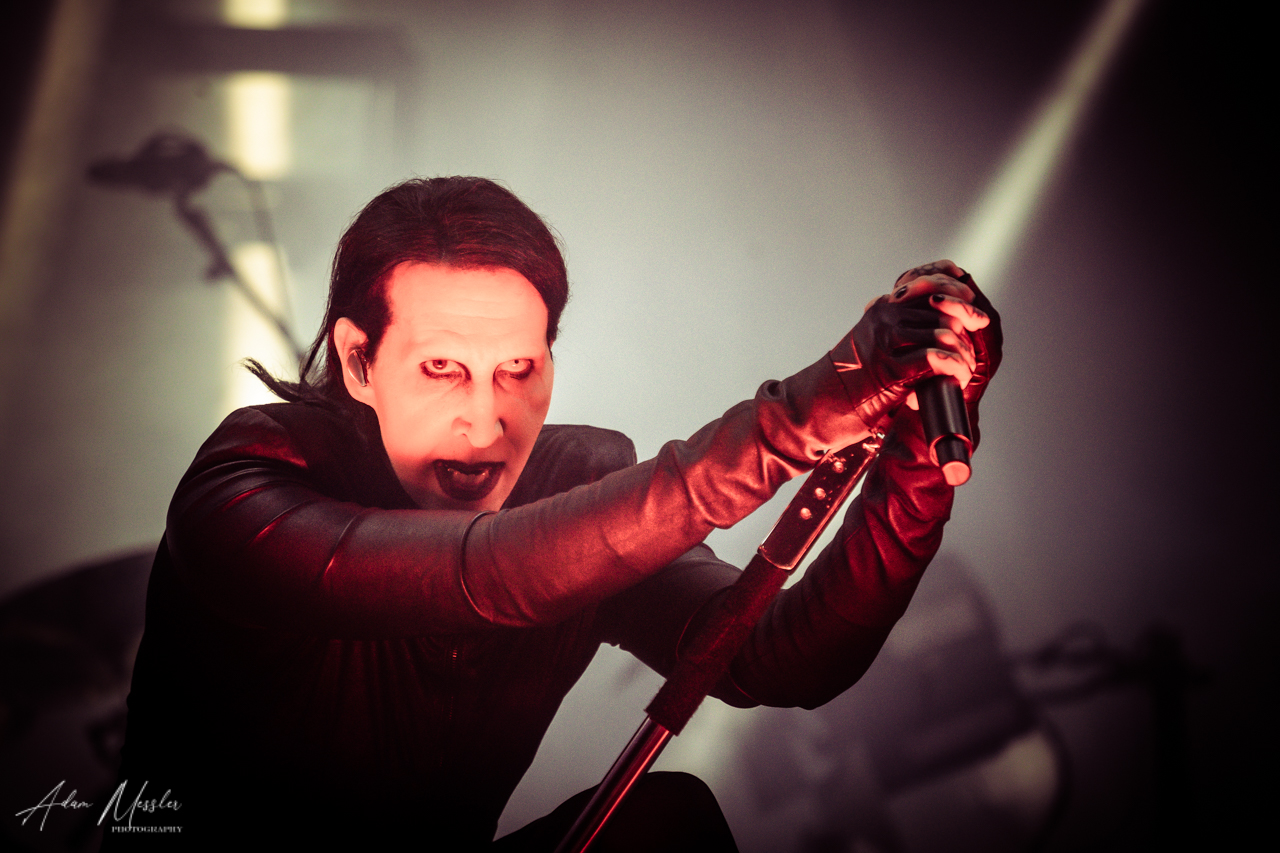
Marilyn Manson’s One Assassination Under God – Chapter 1 felt like a resurrection. Chapter 2 feels like what happens after the body gets back on its feet.
Released August 14, 2026 through Nuclear Blast Records, One Assassination Under God – Chapter 2 is the second half of the creative resurgence Manson began with Chapter 1 in November 2024. Once again working with Tyler Bates as co-writer and co-producer, Manson delivers another nine-song record built around industrial rock, gothic atmosphere, massive guitars and the kind of uncomfortable darkness that has followed his music for more than three decades.
But while the two albums obviously share DNA, they don’t feel identical.
If Chapter 1 was the comeback, Chapter 2 is the confrontation.
Chapter 1: The Resurrection
When One Assassination Under God – Chapter 1 arrived, there was an enormous amount riding on it.
Manson had largely disappeared from the mainstream music landscape, and the album had to accomplish something more difficult than simply delivering nine good songs. It had to prove there was still something creatively worth hearing.
And it did.
Chapter 1 was surprisingly focused. Instead of desperately trying to recreate Antichrist Superstar or Mechanical Animals, Manson and Bates pulled pieces from throughout his career and rebuilt them into something darker, older and more reflective.
The title track opened the record almost like a funeral procession before exploding into something much larger. “As Sick As The Secrets Within” brought an eerie gothic atmosphere, “Sacrilegious” carried some of the swagger of classic Manson, while “Raise The Red Flag” was one of the album’s most aggressive moments.
Then there was “Sacrifice Of The Mass.”
Rather than ending the record with another industrial-metal explosion, Manson closed Chapter 1 with something haunting, vulnerable and almost cinematic.
That became the biggest difference between this era and some of his previous records.
There was anger, but underneath it was mortality.
There was arrogance, but underneath that was damage.
There was still the Marilyn Manson character, but every once in a while you could hear Brian Warner standing behind him.
Musically, critics noted that Chapter 1 moved between goth rock, industrial rhythms, heavy metal, post-punk and more atmospheric territory, while maintaining a surprisingly concise nine-song structure.
Chapter 1 felt like someone crawling out of his own grave.
Chapter 2 sounds considerably less interested in staying there.
Chapter 2: The Weapon Is Loaded Again
The second chapter contains another nine tracks:
- Unalive
- Don’t Answer The Door
- Front Toward Enemy
- All The Vilest Things
- None of the Suns
- Lucifer’s Teardrop
- The Arsonist
- Exit Wound
- Enantiomorph
Even those titles tell you something.
Chapter 1 repeatedly dealt with death, judgment, funerals, purgatory and sacrifice.
Chapter 2 sounds more like aftermath.
Fire.
Enemies.
Wounds.
Lucifer.
Things that survived.
That’s an important distinction.
Where Chapter 1 often sounded introspective, Chapter 2 feels more hostile and outward-facing.
The clearest early example is “Exit Wound.” Nuclear Blast described the song as pushing the sound established on Chapter 1 further into industrial textures, unsettling atmosphere and melodic tension, and that’s really the bridge between these two records.
It doesn’t abandon what worked before.
It sharpens it.
There is still gothic melancholy surrounding this era of Manson, but Chapter 2 carries more teeth.
Instead of asking whether the monster survived, it feels like the monster already knows the answer.
One Assassination Under God Is Really One Album
The biggest compliment that can be given to Chapter 2 is that its existence makes Chapter 1 more interesting.
Rather than feeling like One Assassination Under God plus a collection of leftover songs, the Chapter concept gives the project an actual narrative arc.
Chapter 1 is death and resurrection.
Chapter 2 is survival and retaliation.
Put the two nine-song records together and suddenly you have an 18-track body of work that feels much more ambitious.
The religious language runs throughout both chapters. Manson has spent his entire career weaponizing Christian imagery, but here it feels less like teenage rebellion and more like someone contemplating judgment, martyrdom, death and rebirth.
There’s a major difference between screaming at God when you’re 27 and questioning God, death and your own legacy decades later.
That’s where this era becomes interesting.
Manson isn’t the young Antichrist anymore.
And he doesn’t need to pretend to be.
Chapter 1 vs. Chapter 2
Chapter 1 is more emotional.
Songs such as “As Sick As The Secrets Within,” “Death Is Not A Costume” and especially “Sacrifice Of The Mass” gave the album a vulnerability that isn’t normally associated with Marilyn Manson.
There’s bitterness throughout the record, certainly, but there’s also reflection.
Chapter 2 is darker and more combative.
The industrial side feels increasingly important to the identity of this chapter, while the overall imagery surrounding songs like “Front Toward Enemy,” “The Arsonist” and “Exit Wound” pushes the narrative from mourning toward confrontation.
Chapter 1 often feels like staring into the mirror.
Chapter 2 feels like turning around to confront whoever is standing behind you.
Atmosphere
Chapter 1: Gothic, mournful, introspective.
Chapter 2: Industrial, threatening, confrontational.
Emotion
Chapter 1: Pain.
Chapter 2: Anger.
Story
Chapter 1: I survived.
Chapter 2: Now what?
Overall Sound
Both records maintain the dark rock foundation Manson and Tyler Bates established together, but Chapter 2 pushes further into the sinister industrial textures hinted at during the first chapter. The label itself presented “Exit Wound” as an evolution of Chapter 1 rather than a reinvention, which is exactly how the two albums work best together.
Which Chapter Is Better?
This may ultimately come down to which Marilyn Manson you prefer.
If you enjoy the slower, darker, atmospheric side of Manson—the world of songs like “Coma White,” “The Speed Of Pain,” “Man That You Fear” and some of the more reflective moments from The Pale Emperor—Chapter 1 may remain your favorite.
If you prefer Manson when the industrial machinery starts grinding harder and the music carries more aggression, Chapter 2 may have the edge.
For me, Chapter 1 has the stronger emotional punch.
Chapter 2 has the darker attitude.
But together they’re substantially better than either album is alone.
And that may have been the entire point.
Final Verdict
There was a time when every Marilyn Manson album felt like an event.
Antichrist Superstar.
Mechanical Animals.
Holy Wood.
Each arrived with its own universe.
Later records sometimes contained outstanding songs without creating that same feeling of a complete world.
One Assassination Under God feels different.
Across its two chapters, Marilyn Manson and Tyler Bates have constructed something that feels intentional again.
It’s not an attempt to become the Marilyn Manson of 1996.
It couldn’t be.
Instead, it’s the sound of an artist taking the mythology built around Marilyn Manson—the villain, the Antichrist, the scapegoat, the celebrity, the corpse—and examining what remains after decades of controversy and self-destruction.
Chapter 1 buried Marilyn Manson.
Chapter 2 digs him back up.
And perhaps the most surprising thing about One Assassination Under God is that nearly 30 years after Antichrist Superstar, there’s still enough darkness left in the grave to make the resurrection interesting.
Ratings
One Assassination Under God – Chapter 1: 8.5/10
Dark, atmospheric and surprisingly personal. One of Manson’s strongest and most cohesive records of his later career.
One Assassination Under God – Chapter 2: 9/10
Heavier in attitude, darker in atmosphere and more confident in its purpose. Rather than repeating Chapter 1, it feels like the necessary second act.
The Complete One Assassination Under God Era: 9/10
Taken together, the two chapters make a convincing argument that Marilyn Manson’s latest era isn’t simply a comeback.
It’s a rebirth.